2025-10-06:最小回文排列Ⅱ。用go语言,给定一个本身就是回文的字符串 s 和一个整数 k。把 s 的字符重新排列,找出

2025-10-06:最小回文排列Ⅱ。用go语言,给定一个本身就是回文的字符串 s 和一个整数 k。把 s 的字符重新排列,找出

福大大架构师每日一题
发布于 2025-12-18 13:56:45
发布于 2025-12-18 13:56:45
2025-10-06:最小回文排列Ⅱ。用go语言,给定一个本身就是回文的字符串 s 和一个整数 k。把 s 的字符重新排列,找出所有不同且仍然是回文的字符串,并按字典序从小到大排序。返回这个有序序列中的第 k 个字符串;如果这样的不同回文排列不足 k 个,则返回空字符串。
术语说明(便于理解):
- • 回文:从左到右读与从右到左读相同的字符串。
- • 排列:对原字符串中字符位置进行重新组合得到的新字符串。
- • 唯一性:不同的重排如果生成了相同的回文结果,只计为一个。
- • 字典序比较:逐位比较字符,首个不同处字符较小的一侧字典序更小;若一个字符串是另一个的前缀,则更短的那个更小。
1 <= s.length <= 10000。
s 由小写英文字母组成。
保证 s 是回文字符串。
1 <= k <= 1000000。
输入: s = "abba", k = 2。
输出: "baab"。
解释:
"abba" 的两个不同的回文排列是 "abba" 和 "baab"。
按字典序,"abba" 位于 "baab" 之前。由于 k = 2,输出为 "baab"。
题目来自力扣3518。
解决过程
1. 预处理字符频率统计
- • 计算字符串长度
n和中间位置mid = n/2 - • 创建一个长度为26的数组
counts来统计左半部分每个字符的出现次数 - • 只遍历左半部分字符(索引
0到mid-1),统计每个字符的频率
2. 可行性检查
- • 调用
perm函数计算左半部分所有可能的排列数量 - • 如果排列数量小于
k,说明没有足够的回文排列,直接返回空字符串
3. 构造左半部分字符串
这是核心的贪心构造过程:
- • 从左到右逐个位置确定字符
- • 对于每个位置,按字典序从 'a' 到 'z' 尝试每个可能的字符:
- • 如果该字符在
counts中还有剩余次数,暂时选择它 - • 计算选择当前字符后,剩余位置的所有排列数量:
- • 从
counts中减少当前字符的计数 - • 调用
perm计算剩余字符的排列数
- • 从
- • 如果排列数
>= k:确定选择当前字符,继续处理下一个位置 - • 如果排列数
< k:恢复字符计数,k减去这个排列数,尝试下一个字符
- • 如果该字符在
4. 构建完整回文
- • 左半部分构造完成后:
- • 如果是奇数长度字符串,在中间添加原字符串中间位置的字符
- • 将左半部分反转后拼接到右侧,形成完整的回文
辅助函数说明
perm 函数
计算给定字符频率下的排列数:
- • 输入:剩余位置数
total,字符频率数组counts,阈值k - • 计算多重集合的排列数公式:
total! / (count1! × count2! × ...) - • 使用组合数相乘的方式计算,避免直接计算阶乘的溢出
- • 如果中间结果超过
k,提前返回最大值(优化)
comb 函数
计算组合数 C(n, m):
- • 使用公式:C(n, m) = n×(n-1)×...×(n-m+1) / m!
- • 采用迭代计算,每次乘一个数除一个数,避免大数运算
- • 如果中间结果超过
k,提前返回最大值
示例分析
对于 s = "abba", k = 2:
- • 左半部分字符:'a', 'b',频率:a:1, b:1
- • 可能的左半部分排列:["ab", "ba"]
- • 对应完整回文:["abba", "baab"]
- • 第2个是 "baab"
复杂度分析
时间复杂度
- • 字符频率统计:O(n)
- • 可行性检查:O(26 × n) 最坏情况
- • 构造过程:每个位置最多尝试26个字符,每次尝试需要计算排列数,最坏 O(26² × n)
- • 总体:O(26² × n) = O(676n) ≈ O(n)(因为26是常数)
额外空间复杂度
- • 字符频率数组:O(26) = O(1)
- • 字符串构建器:O(n)
- • 递归调用栈:O(1)(没有递归)
- • 总体:O(n)(主要用于存储结果字符串)
这个算法通过贪心构造和组合数学计算,高效地找到了第k小的回文排列。
Go完整代码如下:
.
package main

import (
    "fmt"
    "math"
    "strings"
)

func smallestPalindrome(s string, k int)string {
    n := len(s)
    mid := n / 2
    counts := make([]int, 26)

    for i := 0; i < mid; i++ {
        c := s[i]
        counts[c-'a']++
    }

    if perm(mid, counts, k) < k {
        return""
    }

    var sb strings.Builder
    for i := 0; i < mid; i++ {
        flag := false
        for c := 'a'; c <= 'z' && !flag; c++ {
            index := int(c - 'a')
            if counts[index] == 0 {
                continue
            }

            counts[index]--
            permutations := perm(mid-i-1, counts, k)
            if permutations >= k {
                sb.WriteByte(byte(c))
                flag = true
            } else {
                counts[index]++
                k -= permutations
            }
        }
    }

    if n%2 != 0 {
        sb.WriteByte(s[mid])
    }

    // Build the right half by reversing the left half
    leftStr := sb.String()
    sb.Reset()
    sb.WriteString(leftStr)

    // Append the reversed left half
    for i := len(leftStr) - 1; i >= 0; i-- {
        if n%2 != 0 && i == len(leftStr)-1 {
            continue// Skip the middle character in odd length case
        }
        sb.WriteByte(leftStr[i])
    }

    return sb.String()
}

func perm(total int, counts []int, k int)int {
    permutations := int64(1)
    for _, count := range counts {
        if count == 0 {
            continue
        }
        combVal := comb(total, count, k)
        ifint64(combVal) > int64(k) {
            return math.MaxInt32
        }
        permutations *= int64(combVal)
        if permutations > int64(k) {
            return math.MaxInt32
        }
        total -= count
    }
    returnint(permutations)
}

func comb(n, m, k int)int {
    if m > n-m {
        m = n - m
    }
    combinations := int64(1)
    for i, j := n, 1; j <= m; i, j = i-1, j+1 {
        combinations = combinations * int64(i) / int64(j)
        if combinations > int64(k) {
            return math.MaxInt32
        }
    }
    returnint(combinations)
}

func main() {
    s := "abba"
    k := 2
    result := smallestPalindrome(s, k)
    fmt.Println(result)
}
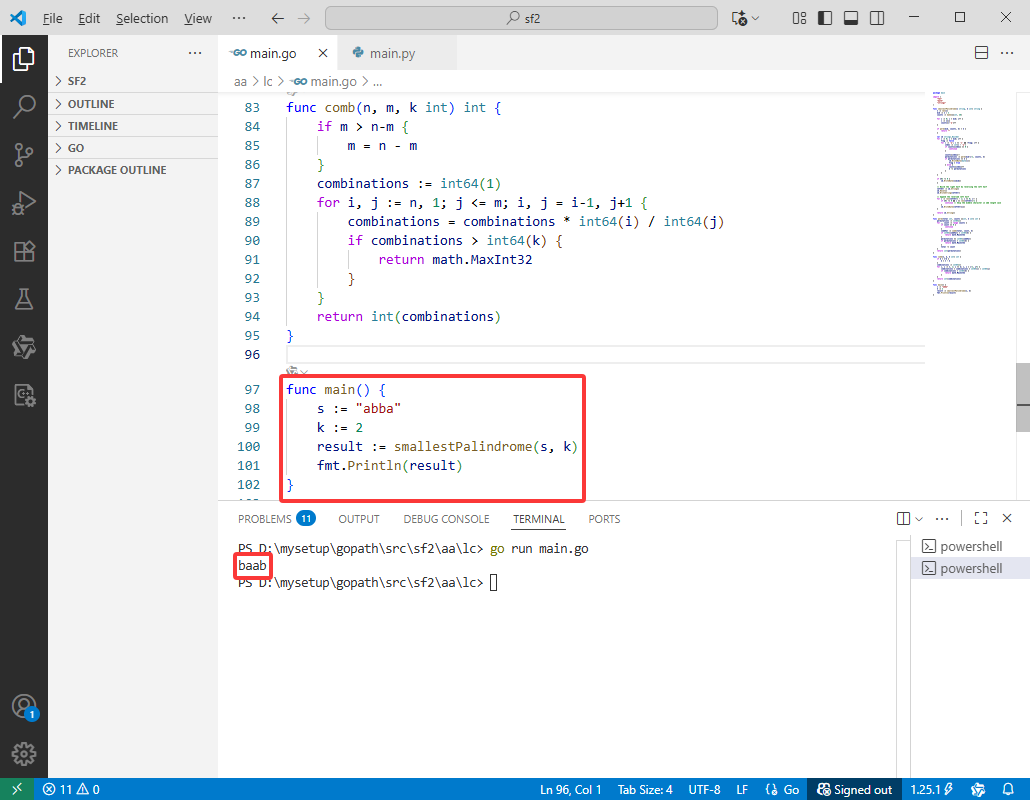
Python完整代码如下:
.
# -*-coding:utf-8-*-

import math

def smallestPalindrome(s: str, k: int) -> str:
    n = len(s)
    mid = n // 2
    counts = [0] * 26

    for i in range(mid):
        c = s[i]
        counts[ord(c) - ord('a')] += 1

    if perm(mid, counts, k) < k:
        return""

    sb = []
    for i in range(mid):
        flag = False
        for c in range(ord('a'), ord('z') + 1):
            if flag:
                break
            index = c - ord('a')
            if counts[index] == 0:
                continue

            counts[index] -= 1
            permutations = perm(mid - i - 1, counts, k)
            if permutations >= k:
                sb.append(chr(c))
                flag = True
            else:
                counts[index] += 1
                k -= permutations

    if n % 2 != 0:
        sb.append(s[mid])

    # Build the complete palindrome
    left_str = ''.join(sb)
    if n % 2 != 0:
        # For odd length, the middle character is already included
        right_str = left_str[-2::-1]  # Reverse excluding the middle character
    else:
        right_str = left_str[::-1]  # Reverse the entire left half

    return left_str + right_str

def perm(total: int, counts: list, k: int) -> int:
    permutations = 1
    for count in counts:
        if count == 0:
            continue
        comb_val = comb(total, count, k)
        if comb_val > k:
            return math.inf
        permutations *= comb_val
        if permutations > k:
            return math.inf
        total -= count
    return permutations

def comb(n: int, m: int, k: int) -> int:
    m = min(m, n - m)
    combinations = 1
    i, j = n, 1
    while j <= m:
        combinations = combinations * i // j
        if combinations > k:
            return math.inf
        i -= 1
        j += 1
    return combinations

# Test
if __name__ == "__main__":
    s = "abba"
    k = 2
    result = smallestPalindrome(s, k)
    print(result)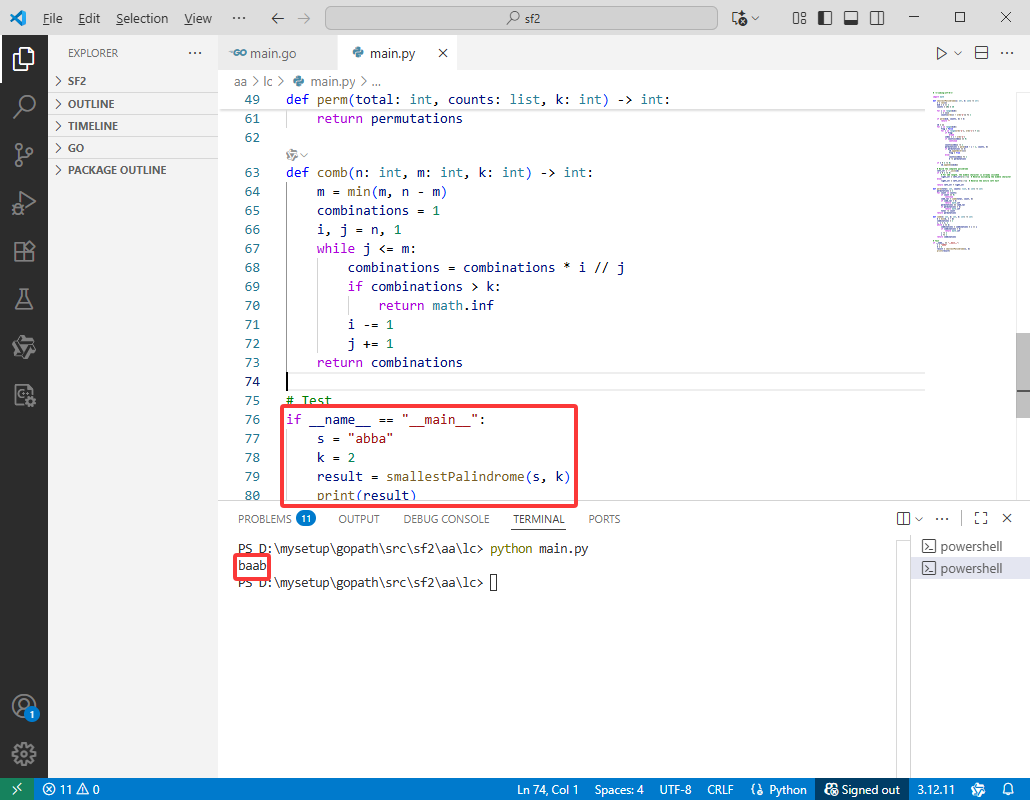
我们相信人工智能为普通人提供了一种“增强工具”,并致力于分享全方位的AI知识。在这里,您可以找到最新的AI科普文章、工具评测、提升效率的秘籍以及行业洞察。 欢迎关注“福大大架构师每日一题”,发消息可获得面试资料,让AI助力您的未来发展。
本文参与 腾讯云自媒体同步曝光计划,分享自微信公众号。
原始发表:2025-10-06,如有侵权请联系 cloudcommunity@tencent.com 删除
评论
登录后参与评论
推荐阅读
目录
腾讯云开发者

Copyright © 2013 - 2026 Tencent Cloud. All Rights Reserved. 腾讯云 版权所有
深圳市腾讯计算机系统有限公司 ICP备案/许可证号:粤B2-20090059  粤公网安备44030502008569号
腾讯云计算(北京)有限责任公司 京ICP证150476号 | 京ICP备11018762号